
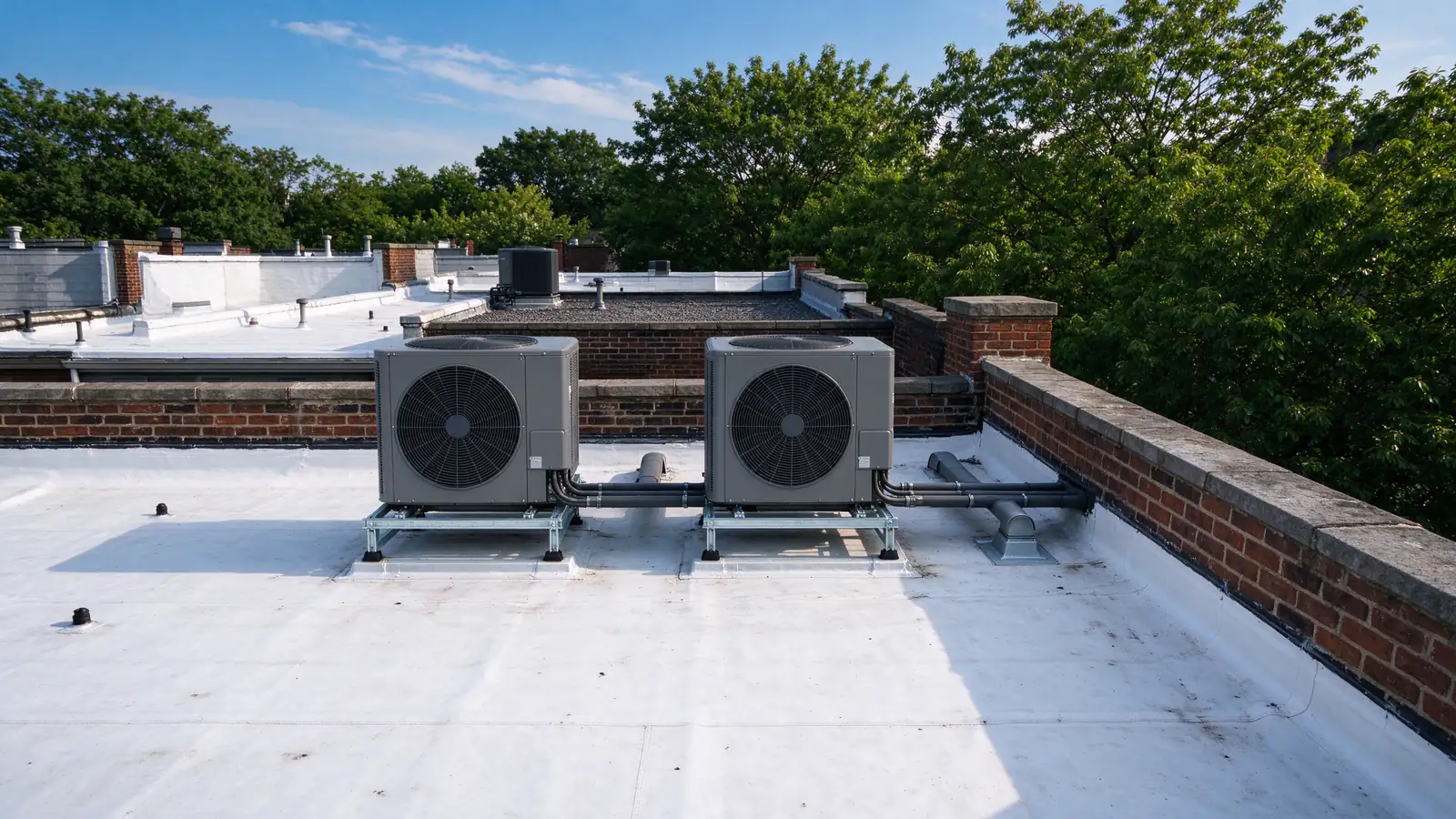
Bought a condo in a converted Dupont Circle, Logan Circle or Shaw townhouse and want to replace a tired system? Expect two separate sign-offs before any work starts: one under your condominium’s own documents, and one from the Historic Preservation Office for whatever ends up on the roof or rear wall. At Perennial DC Heat Pumps we plan ducted air-source heat pump installation and replacement for townhouses and condo units across Dupont Circle, Logan Circle, Shaw, U Street, LeDroit Park, Bloomingdale and the Strivers’ Section.
Neither approval stands in for the other, and neither replaces the DOB mechanical permit every new or replacement system needs. We work through all three in order.
Who has to say yes before work starts?
Your condominium goes first, because it controls the space. DC Code § 42-1902.24(a) lets you improve the inside of your unit but bars changes to the exterior appearance of the unit or any other part of the condominium except as the instruments allow. Your declaration and bylaws, not the statute, set the approval process.
Who owns the roof and walls comes from the same documents. Under § 42-1902.06, apparatus outside your unit that serves only your unit is treated as a limited common element unless the instruments say otherwise, while ducts serving more than one unit are common elements. So a rooftop condenser for the top-floor unit and a line set through a shared stairwell can fall under different rules in the same building.
HPO comes next wherever the address is inside a historic district: DOB forwards the permit and HPO judges the exterior change by how visible it is. Our condo guide and historic homes guide cover each layer.
Is the roof your only outdoor space?
In a converted townhouse condo, it often is. HPO’s roof guidelines ask for HVAC equipment placed so a public street cannot see it, and where that cannot be done, screened in keeping with the building’s proportion, scale, materials and color.
Setback is our main tool. We pull the condenser toward the back of the roof, away from the cornice, so it drops out of the sightline from the sidewalk across the street. Under HPO’s review tiers, a roof alteration that needs a site visit or mock-up and is then found not visible from street views goes to staff review, typically about 5 days. Visible equipment, or a roof deck built alongside it, can go to the Historic Preservation Review Board.
A roof spot also brings in structure. We set the stand on joists, not on the membrane alone, and we plan flashing for the line penetration that the roofing warranty holder will accept.
No basement, no attic: where does the air handler go?
Usually into a closet, a soffit or the space above a hallway ceiling, since a townhouse condo rarely has a basement or attic of its own. That favors compact horizontal or multi-position models, and it makes the condensate drain and overflow pan part of the design. Our air-handler page explains the overflow protection we plan when a downstairs neighbor’s ceiling is below.
We size to your unit’s load, not the building’s. A middle-floor unit with neighbors above and below loses far less heat than the top unit under the roof, even with the same floor area. The sizing guide shows our room-by-room method at 14°F, the ENERGY STAR heating design temperature for Washington.
Power is the other limit. Your unit’s panel may be small, and the building’s service may cap what one owner can add. The electrical requirements guide covers when a circuit is enough and when you need a heavy-up.
Put these questions into a project brief
Describe what you know about the property. Technical unknowns can stay unknown.
Seven district names, seven address lookups
HPO’s list of 70 districts includes every name below, plus Fourteenth Street, Blagden Alley Naylor Court and Mount Vernon Square nearby. The names overlap but the boundaries do not match the neighborhoods, so we start with HPO’s district map.
Dupont Circle
The DC Office of Planning notes that older townhouses help define Dupont Circle and that Connecticut Avenue has larger early-twentieth-century apartment buildings. If your unit is in one of those apartment buildings, the condo instruments carry most of the weight.
Logan Circle
Older townhouses and mid-rise buildings shape Logan Circle. If your townhouse faces the circle itself, the front and roofline are highly visible, so rear-roof placement matters most here.
Shaw
Shaw mixes older townhouses with mid-rise buildings, and the 14th Street corridor carries modern high-density development. If your unit is in a newer building, the condo’s rules still govern, and even a recent building can fall inside the Fourteenth Street district.
U Street
U Street has a designated historic district of its own. If your rowhouse is inside it, a condenser in a walled rear patio that no street can see is minor HPO work.
LeDroit Park
LeDroit Park is one of the Mid-City rowhouse neighborhoods, with its own historic district. If your conversion changes ductwork across floors, our ductwork service page covers rerouting.
Bloomingdale
Bloomingdale is another Mid-City rowhouse neighborhood with a designated district. If your front yard is DDOT public parking, we settle the public-space question before planning any equipment there.
Strivers’ Section
The Strivers’ Section is its own designated historic district. If your building has been split into condos, both the instruments and HPO apply to any visible change.
Our order of work for a condo in a historic district
We begin with the condominium: we get the instruments, work out whether the roof or wall is a common or limited common element, and request approval under the bylaws. Then we design, drawing the condenser position, screen and line-set route to satisfy both reviewers at once.
Next we line up the DOB filing: the Class E refrigeration permit fee is $50.60 for equipment up to 120,000 BTU/h, and a general electrical instant permit is $22. Inside a district, HPO reviews before DOB issues. Individual condo units in larger buildings can qualify for DCSEU rebates when the job meets DCSEU’s contractor and paperwork rules, which the rebate guide lays out.
What a heat pump costs in a Dupont, Logan or Shaw condo
Our typical range for a whole-home ducted installation or like-for-like replacement is $8,000 to $18,000 before rebates. The written estimate after the site visit sets your price. Townhouse condo jobs here go above it when a roof position needs a structural stand or a crane lift, when HPO asks for a screen, or when we have to build ducts into soffits in a finished unit.
The cost guide and cost estimator show which items sit outside the base scope. Our quote checklist lists the approvals an estimate should name, and the contact page takes your building type and condo status.
Areas around Dupont, Logan and Shaw
Capitol Hill covers rowhouses with rear yards and alleys. Columbia Heights, Mount Pleasant and Adams Morgan covers rowhouses split into flats. Downtown, Navy Yard and Southwest covers high-rise condo units. Our full coverage is on the service areas page.
Questions for this area
Does DC law require condo board approval for a heat pump on a Dupont Circle roof?
The statute leaves that to each building. DC Code § 42-1902.24 bars changes to the exterior appearance of the condominium except as its instruments allow, so your declaration and bylaws set who approves a rooftop unit and how. We read them with you before we draw anything.
How long does HPO take to review a rooftop heat pump in Logan Circle?
When HPO needs a site visit or mock-up and then finds the roof unit not visible from street views, staff review typically takes about 5 days. A rooftop unit the street can see can go to the Historic Preservation Review Board, which takes longer, so we set the unit back from the cornice wherever the roof allows.
Can a Shaw condo owner get a DCSEU heat pump rebate?
Yes, it can. Individual condo and co-op units in larger buildings can qualify, as can buildings of up to four units. DCSEU's rules call for a DOB mechanical permit and the AHRI certificate among other documents, and we check current amounts on dcseu.com before we quote them.
What should a Dupont or Logan Circle townhouse condo expect to spend on a heat pump?
Our typical range for a whole-home ducted installation or like-for-like replacement is $8,000 to $18,000 before rebates, and the written estimate after the site visit sets your price. A structural roof stand, a crane lift, a historic screen or new soffit ducts move a condo project above it.
Is a U Street or Bloomingdale rowhouse automatically in a historic district?
No. Both names match designated districts, but district lines do not follow neighborhood names. We look up your exact address on HPO's historic district map before we plan any exterior equipment.