
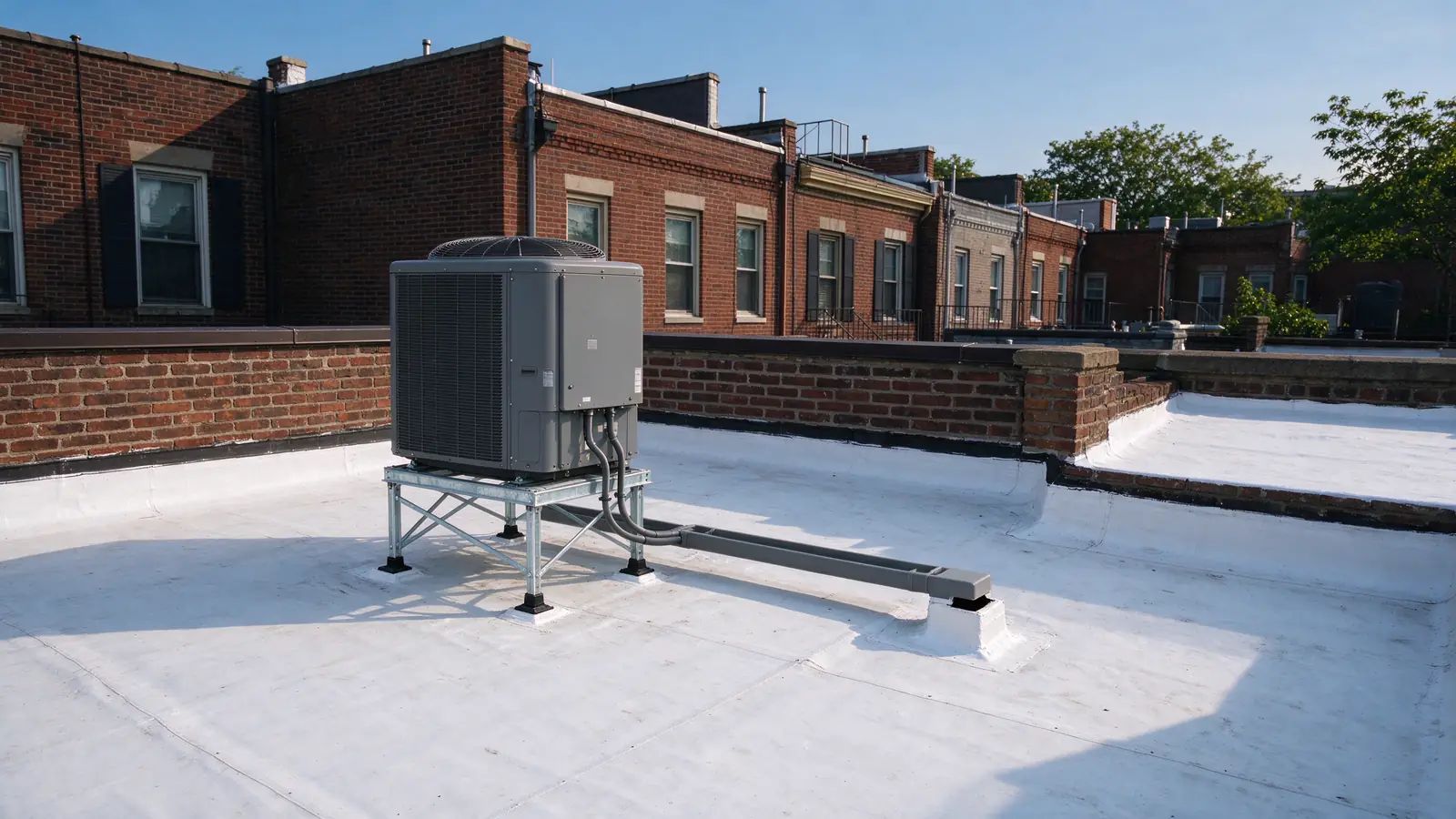
Own a tall Columbia Heights or Mount Pleasant rowhouse that has been split into two or three flats? Then your first heat pump question is not which brand, but how many systems. At Perennial DC Heat Pumps we plan ducted air-source heat pump installation for rowhouses, flats and apartments across Columbia Heights, Mount Pleasant, Park View, Pleasant Plains, Adams Morgan and Kalorama.
We count the systems before anything else, because that number drives the rest: how many outdoor units squeeze into a narrow rear yard, whose panel feeds each one, and who holds the thermostat.
Two households, one heat pump?
That arrangement rarely ends well. Once a rowhouse is split, legally or just in practice, we usually recommend a separate system for each unit: its own outdoor unit, air handler, thermostat and circuit. The household using the heat pays for it and books its own service. One shared system ties every flat to a single thermostat and breaker, which suits one family living on all floors but frustrates two separate households.
A condo rowhouse raises the stakes. DC Code § 42-1902.06 treats ducts and other apparatus serving more than one unit as common elements unless the condominium instruments say otherwise, so a shared heat pump becomes association property to repair and replace. Our condo guide covers that ownership split.
Bedrooms upstairs never cool down?
In a single-family rowhouse kept whole, warm air climbs the open stairwell and parks on the top floor. Bedrooms up there run hot in July, when the normal mean at Reagan National is 81.0°F, while the parlor floor can feel cold in a January averaging 37.5°F. A basement air handler on its own rarely balances those floors through old, small ducts.
We usually fix that with two systems stacked by floor: one in the basement or first floor for the lower levels and one in the attic or a top-floor closet for the bedrooms. We size each to its own floors’ load at 14°F, the ENERGY STAR heating design temperature for Washington, as the sizing guide explains. Our rowhouse guide compares stacked and zoned layouts, and the ductwork service page covers new trunks through tight chases.
Two outdoor units in one narrow yard need the manufacturer’s clearances between them and from the walls, plus a drain path for both units’ defrost water, so we plan them as a pair.
Is your house in the Mount Pleasant or Kalorama Triangle district?
It might be. HPO’s list of 70 districts includes Mount Pleasant and Kalorama Triangle, along with nearby Meridian Hill and Sheridan Kalorama. Inside any of them, DOB forwards your permit to HPO. A condenser the street clearly cannot see is minor work that HPO typically clears in 1 to 3 days under its review tiers; a visible or rooftop unit takes longer and may need screening.
We run the same lookup for Columbia Heights, Park View and Pleasant Plains addresses, because district lines do not follow neighborhood names. Our historic homes guide walks through both outcomes.
Put these questions into a project brief
Describe what you know about the property. Technical unknowns can stay unknown.
Six neighborhoods, six kinds of building
The DC Office of Planning counts Columbia Heights, Mount Pleasant and Adams Morgan among the city’s rowhouse neighborhoods. Here is what tends to change from one to the next.
Columbia Heights
If your Columbia Heights rowhouse was converted to flats, each unit may already have its own electric meter. That makes one heat pump per unit the straightforward electrical design.
Mount Pleasant
Mount Pleasant has a historic district. If your house sits inside it, a second rear condenser still counts as minor work as long as no street can see it.
Park View and Pleasant Plains
Rowhouse blocks in Park View and Pleasant Plains have the same upstairs airflow problem. If your rowhouse kept its original radiators and has no ducts at all, we have to create supply and return paths from scratch, which makes it a ductwork project as much as an equipment one.
Adams Morgan
Columbia Road holds larger apartment communities. If your unit is in a condominium building, DC Code § 42-1902.24 bars exterior changes except as the condominium instruments allow, so the building’s documents decide where any outdoor unit can go.
Kalorama
Kalorama Triangle is a designated historic district, so exterior equipment there follows the HPO path above. If your Kalorama building runs a shared water loop instead of individual split systems, the job falls outside the air-source split systems we plan.
How we plan a rowhouse split into flats
We start by mapping each unit’s meter, panel and current heating fuel, then run a room-by-room load for each flat. Then we draft outdoor positions for every unit at once, so the second condenser never gets squeezed into leftover space.
We line up permits per system. The DOB Class E refrigeration permit fee is $50.60 for equipment up to 120,000 BTU/h, and DOB’s instant mechanical permit covers no more than one new air conditioning unit. A heavy-up uses a $64.90 instant permit. Our electrical requirements guide explains panel capacity flat by flat.
Paying for two or three systems instead of one
Our typical range for a whole-home ducted installation or like-for-like replacement is $8,000 to $18,000 before rebates. The written estimate after the site visit sets your price. A rowhouse split into three flats, each with its own system, is three separate scopes, each with its own equipment, line set and permit.
A single scope climbs above that range when we build ducts where radiators used to do the work, when an attic air handler needs a new platform and drain, or when a flat’s panel needs a heavy-up. DCSEU’s residential rebates cover DC buildings with up to four units, so a two- or three-flat rowhouse can qualify, with a $15,000 yearly cap per household. DCSEU also currently offers up to $2,000 toward a heavy-up to 200 amps and $400 per new circuit, up to three. The rebate guide explains per-unit applications, the cost guide and estimator separate the extras, the replacement service page covers like-for-like swaps, and our contact page takes your project details.
Close to Columbia Heights and Mount Pleasant
Dupont Circle, Logan Circle and Shaw adds condo approval to historic review. Cleveland Park and Woodley Park covers detached houses with side yards. Petworth, Brightwood and Takoma covers porch-front rowhouses farther north. Every area we serve is on the service areas page.
Questions for this area
Should each flat in a converted Columbia Heights rowhouse get its own heat pump?
Usually yes. With a system per flat, each household gets its own thermostat, circuit and service schedule, and pays for the heat it uses. In a condo rowhouse, ducts on a shared system become common elements under DC Code § 42-1902.06 unless the instruments say otherwise, which is one more reason we lean toward separate systems.
Can a Mount Pleasant rowhouse fit two condensers in one narrow rear yard?
Often, if the yard leaves the manufacturer's clearances between the units and from walls, plus a drain path for defrost water. We lay both out at once. Inside the Mount Pleasant historic district, units no street can see remain minor work for HPO.
Does DCSEU treat a three-unit Park View rowhouse as residential?
Yes. DCSEU's residential heat pump rebates cover DC buildings with up to four units. Each household is capped at $15,000 in rebates a year, and amounts change between program years, so we check dcseu.com before we put rebate figures in your estimate.
What should a Columbia Heights flat or whole rowhouse budget for a heat pump?
Our typical range for a whole-home ducted installation or like-for-like replacement is $8,000 to $18,000 before rebates, and the written estimate after the site visit sets your price. Three flats each getting a system are three scopes, and new ducts in a radiator-heated house push a single scope higher.
Who decides whether a Columbia Road condo apartment can add an outdoor unit?
The condominium instruments do. DC Code § 42-1902.24 bars a unit owner from changing the exterior appearance of the building except as those documents allow, so we read the declaration and bylaws with you before any design work.