
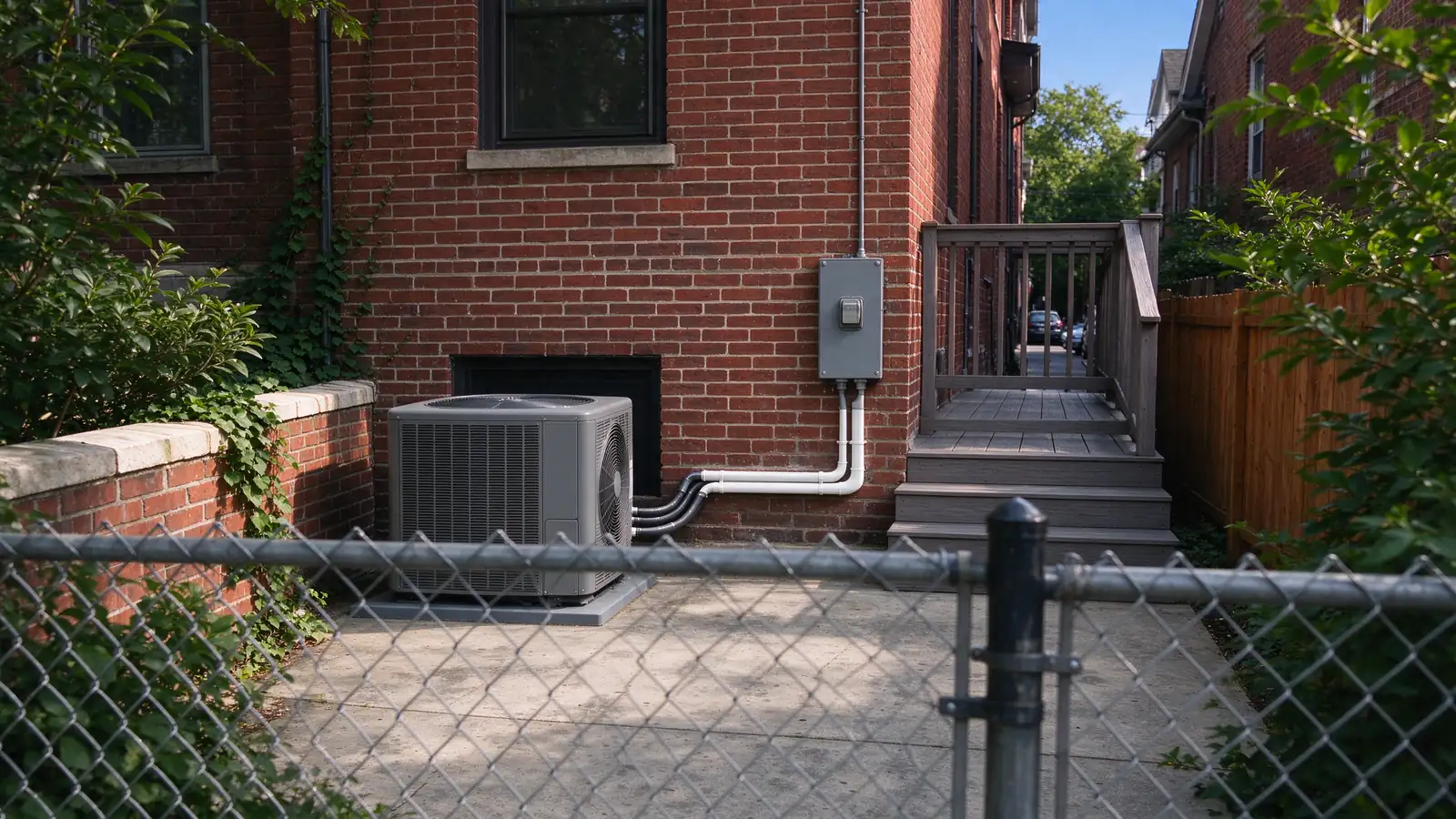
The furnace in a Petworth, Brightwood or Takoma porch-front house almost always sits in the basement, and so do the complaints: it heats the first floor fine, while the bedrooms two flights up never feel right. At Perennial DC Heat Pumps we plan ducted air-source heat pump installation for these rowhouses, semi-detached houses and bungalows, starting with two questions: can your basement ductwork reach the top floor, and where can the outdoor unit legally stand?
The DC Office of Planning’s Rock Creek East element identifies rowhouse and semi-detached neighborhoods through Petworth, Brightwood Park, Brightwood, Manor Park and Lamond Riggs, and wood-frame bungalows and Victorian houses in Takoma.
Basement unit, but the top-floor bedrooms stay hot?
A basement air handler is still our default where a house has a usable basement: it sits next to the trunk duct and drains easily. Its weakness is distance. Supply air climbs two floors through narrow wall cavities, and the bedrooms at the top get the least of it in summer.
How we fix that depends on your ducts. Undersized risers to the second floor, one central return and leaky basement joints are the usual limits in older attached houses, and a new heat pump cannot overcome them on its own. During the survey we measure static pressure and room airflow, then decide whether to enlarge risers, add a high return upstairs, or suggest a small ductless supplement, which is outside the ducted work we plan. The ductwork page and our rowhouse guide explain each option.
Can the condenser go in your front yard?
Often not without a fight, because many DC front yards are public space. DDOT describes public space as the right-of-way between private property lines, often including the front and side yards between sidewalks and buildings, and its design manual calls that strip “public parking”. DC rules bar walls, fences or other structures on a parking without written authority, so if a condenser on the porch-side lawn is the only option, we settle the public-space question with DDOT before anything is ordered.
A rear yard or alley-side pad sidesteps that entirely and usually shortens the line run to a basement air handler. On a narrow semi-detached lot, the open side yard comes next, subject to the 60 dB(A) property-line limit for heat pump equipment in 20 DCMR § 2801.2. We compare the model’s rated sound level with its distance to the shared lot line.
Drafty Takoma bungalow, or inside the historic district?
Wood-frame houses lose heat differently from brick rowhouses. Balloon framing, where a house has it, can leave open wall cavities that let air run from basement to attic, so air sealing changes the load as much as insulation does. We build that into the room-by-room load and test each heat pump’s capacity at ENERGY STAR’s 14°F design temperature for Washington, as the sizing guide describes. Where heat loss stays high, a cold-climate heat pump holds more output at low temperatures.
Takoma Park is on the HPO historic district list; that is the DC district, not the Maryland city. For a house inside its boundary, DOB forwards the permit to HPO. HVAC equipment clearly not visible from a street is minor, routine work, typically approved within 1 to 3 days, which is one more reason we put the condenser behind the house. Our historic homes guide covers visible spots.
Put these questions into a project brief
Describe what you know about the property. Technical unknowns can stay unknown.
Petworth to Lamond Riggs, street by street
Petworth, Brightwood Park and Crestwood
Rowhouses and semi-detached houses dominate Petworth and Brightwood Park, and the plan records apartment-to-condominium conversions in Brightwood Park. If you own a unit in a converted building, your condominium instruments govern, so our condo guide applies. Crestwood belongs to the same planning cluster; if your house there is larger and fully detached, a two-zone layout may make more sense.
Brightwood and Manor Park
Brightwood and Manor Park include rowhouse and semi-detached blocks. If your house shares a side wall with its pair, the open side or the back is the natural spot for the outdoor unit, with the line set running down into the basement.
Takoma
Takoma’s bungalows and Victorian houses vary in what sits under the first floor. If yours has a crawl space instead of a full basement, the air handler may move to an attic or a closet, which changes the duct design completely.
Fort Totten and Lamond Riggs
Lamond Riggs includes rowhouse and semi-detached housing, and the plan notes 1950s residential development around Fort Totten. If your house from that period already has central ducts sized for cooling, a straight heat pump replacement can be more practical than in older blocks.
How we run a porch-front house project
- We survey the basement: air handler, trunk, risers, returns and electrical panel.
- We choose the outdoor spot, starting at the back or alley side, and check whether the address is in a historic district or fronts public parking.
- We size each room against the load, then pick equipment rated at 14°F.
- We line up the DOB mechanical permit ($50.60) and any electrical permit, such as the $22 general instant permit for a new circuit, before work starts.
- If you are converting, the furnace comes out; then the system is commissioned and we send the DCSEU paperwork within 30 days.
Removing a gas furnace qualifies for the current DCSEU conversion tier of $4,000, or $5,000 for an ENERGY STAR Most Efficient model, once the gas heating is gone and that removal is documented in the application. If you keep gas for cooking or hot water, the house stays in the dual-fuel category, and we do not count on that tier.
What pushes a Petworth or Takoma price up
Our typical range for a whole-home ducted installation or like-for-like replacement is $8,000 to $18,000 before rebates. The written estimate after the site visit sets your price. Attached houses here move above it mostly through duct work: new risers cut through finished walls, an added upstairs return or a rebuilt basement trunk. A panel that needs a heavy-up, a public-space application or historic review in Takoma adds its own scope.
Our cost page shows what the base includes, and the cost estimator keeps those additions visible. Check any estimate against the quote checklist, read the rebate guide, and send your project details with a few basement photos.
Areas around Petworth and Takoma
To the south, multi-unit rowhouses are on the Columbia Heights, Mount Pleasant and Adams Morgan page. East of the rail line, deep-lot houses appear on the Brookland and Northeast page, and west of Rock Creek, larger detached houses are on the Upper Northwest page. The full map is on service areas.
Questions for this area
Why are the top-floor bedrooms in my Petworth rowhouse the hardest to cool?
Supply air from a basement air handler travels two floors through narrow risers, and a single central return starves the upstairs. A new heat pump cannot overcome undersized ducts on its own, so we measure static pressure and room airflow first, then plan larger risers or an added upstairs return before we choose equipment.
Can the outdoor unit go in the front yard of a Brightwood porch-front house?
We settle the public-space question first. DDOT says public space often includes front yards between sidewalk and building, and DC rules bar structures on that strip without written authority. A rear yard, alley-side pad or open side yard avoids the issue and usually shortens the line route to your basement.
Does a house in the Takoma historic district need HPO approval for a heat pump?
If the address is inside the DC Takoma Park district boundary, DOB forwards the permit to HPO. HVAC equipment clearly not visible from a street is minor, routine work, typically approved within 1 to 3 days. Visible equipment takes longer and may need screening, so we check your address against HPO's district map before we pick a spot.
What is a realistic budget for a heat pump in a Petworth or Manor Park rowhouse?
Our typical range for a whole-home ducted installation or like-for-like replacement is $8,000 to $18,000 before rebates, and the written estimate after the site visit sets your price. Attached houses here move above it mainly through duct changes such as new risers or an upstairs return, plus any heavy-up, public-space application or historic review.
Can a Brightwood Park condo owner follow the same plan as a rowhouse owner?
No. The planning record notes apartment-to-condominium conversions in Brightwood Park, and in a converted building DC Code § 42-1902.24 leaves exterior changes to the condominium instruments. We check with you which equipment the documents assign to your unit and what the association requires before we choose an outdoor spot.