
Big detached houses in Upper Northwest share a complaint: one floor is comfortable while another is too hot or too cold, no matter where the thermostat sits. At Perennial DC Heat Pumps we plan ducted air-source heat pump installation for these houses, and the first thing we settle is one system or two zones, worked out from a room-by-room load rather than the tonnage of the furnace and air conditioner you have now.
The DC Office of Planning’s Rock Creek West element describes single-family neighborhoods across American University Park, Forest Hills, the Palisades and Spring Valley, with hilly ground near stream valleys. House size and slope are what change our plan here.
Second floor hot, first floor cold in a big house?
That is physics, not a bad thermostat. Warm air rises and the sun hits upper rooms hardest, so a single blower serving a basement, two living floors and a finished attic struggles all summer. We usually plan two systems, one for the lower floors and one for the top, so each runs at the load it actually sees. Where there is only one practical outdoor spot, a single variable-speed system with motorized zone dampers is our alternative.
What tips the decision is the measured load on each floor, whether your existing ducts split cleanly, and whether the lot has room for a second outdoor unit. We check each candidate’s heating capacity at 14°F, ENERGY STAR’s heating design temperature for Washington, against the heat loss of the zone it serves. The sizing guide shows how we build that load, and the ductwork page covers splitting a trunk into zones.
Is the attic air handler on its last legs?
If your top floor runs off an attic air handler, replacing it comes with its own limits. The pull-down stair or hatch caps the cabinet size, a secondary drain pan and float switch have to protect the ceiling below, and summer attic heat cuts the capacity that reaches your rooms when ducts run outside the insulation.
We treat an attic replacement as the moment to seal and insulate those ducts, or move them inside the conditioned part of the house. Our air-handler replacement page explains how a matched indoor coil and blower affect efficiency, and why the rebate file needs an AHRI certificate for the matched indoor and outdoor pair.
Steep yard, big trees: where can the outdoor unit sit?
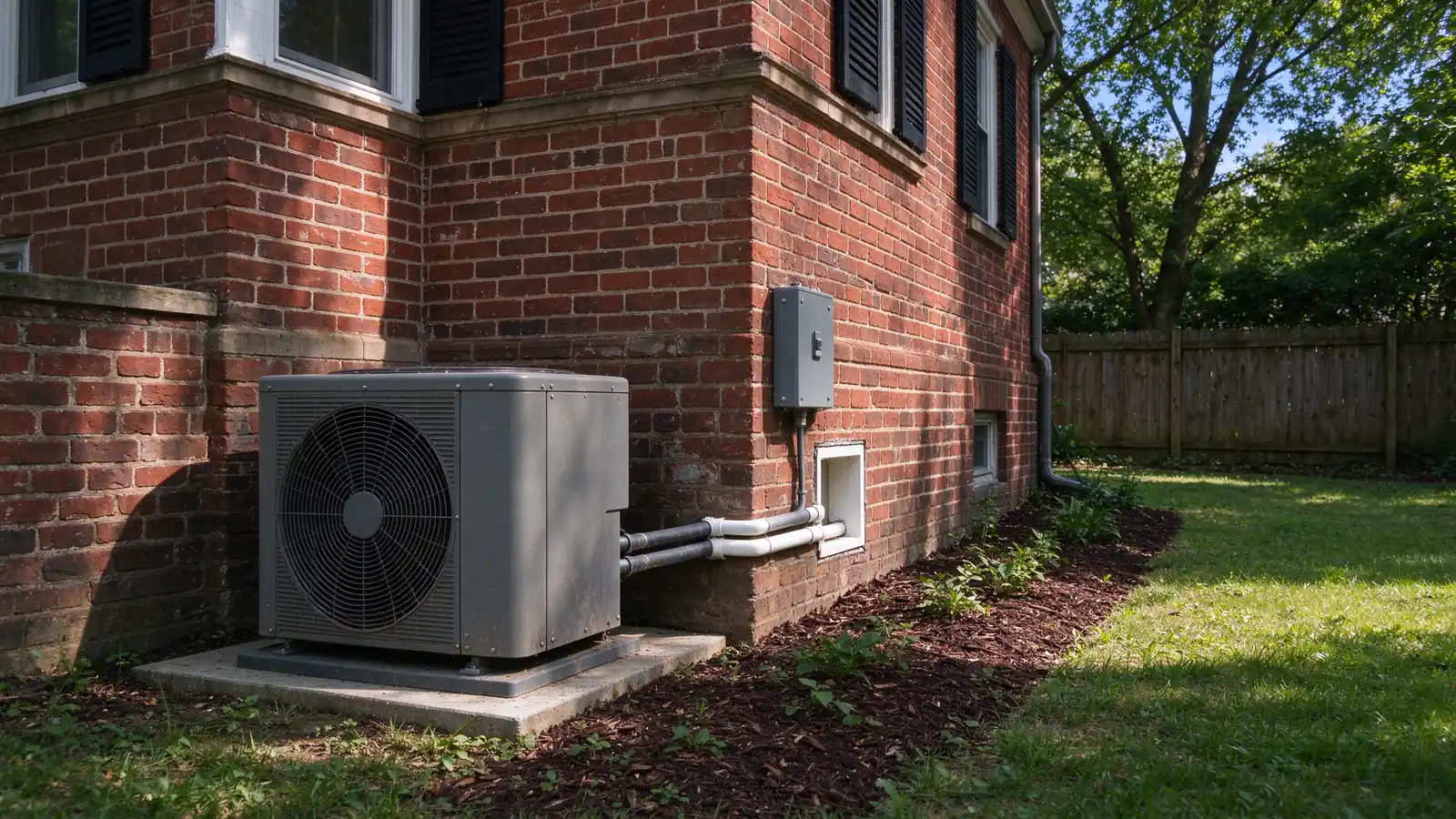
On a hilly lot near a stream valley, placing the condenser becomes a grading question. We set a level pad clear of the downhill drainage path, with airflow room around it and a line route that does not cross a retaining wall or root zone without a plan. Washington averages about 13.8 inches of snow a season, according to the NWS, so we set pad height and meltwater drainage by your site and the manufacturer instructions rather than a fixed stand height.
On a side yard, sound matters. DC caps heat pump and air-conditioning equipment at 60 dB(A) at the property line, and residential zones generally at 55 dB(A) at night, both in the DOB noise handbook. We compare each model’s rated sound level with its distance to your lot line before choosing a side yard over the back.
Ready to get rid of the gas furnace?
The biggest rebate open to an Upper Northwest house depends on removing gas heat, not on swapping like for like. Current DCSEU tiers pay $4,000 for an ENERGY STAR ducted heat pump replacing gas heat and $5,000 for an ENERGY STAR Most Efficient model, against $1,000 and $1,500 when electric heat is replaced. The conversion tier needs proof the fuel system was removed, and DCSEU’s form limits that method to fully electrified homes, so a gas range or water heater left in place blocks it.
That makes furnace-to-heat-pump conversion and dual fuel two financially separate paths. Keeping the furnace as backup can suit a very large house, but we do not budget it with the conversion rebate. DCSEU caps total rebates at $15,000 per household per year, and we confirm current terms on dcseu.com.
Put these questions into a project brief
Describe what you know about the property. Technical unknowns can stay unknown.
Chevy Chase to Glover Park, house by house
Chevy Chase, Barnaby Woods and Hawthorne
Connecticut Avenue links Chevy Chase with mid- and high-rise residences, while Barnaby Woods and Hawthorne sit on hilly ground near stream valleys. If you live in an apartment on the avenue, condo rules apply; a detached house uphill follows the grading and zoning logic above.
Tenleytown, American University Park and Friendship Heights
American University Park is mostly single-family, and Wisconsin Avenue joins the Tenleytown and Friendship Heights shopping centers. We treat a house here as residential scope; mixed-use premises on the avenue are a different kind of job.
Forest Hills and Van Ness
Forest Hills holds single-family houses, and Van Ness has mid- and high-rise residences beside institutions. If your Van Ness apartment shares building equipment, our condo guide applies instead.
Palisades, Spring Valley and Wesley Heights
The plan describes the wooded Potomac Palisades and hilly Spring Valley. Long, sloping backyards can mean longer line sets and a pad built into the grade. Foxhall Village, at the edge of this area, is on HPO’s historic district list, so we check the boundary for any address there.
Glover Park and Cathedral Heights
Glover Park is established rowhouse territory, and the McLean Gardens apartments in Cathedral Heights were converted to condominiums. Those homes follow our rowhouse guide or condo rules rather than the two-zone detached pattern.
Our order of work on a two-zone conversion
- We run a load calculation floor by floor and inspect the ducts in the basement and attic.
- We decide on one zoned system or two systems, and pick outdoor spots that pass the property-line sound check.
- We size the electrical load. Two heat pumps plus resistance backup can push a 100-amp service toward a heavy-up; DCSEU currently contributes up to $2,000 toward a heavy-up to 200 amps and $400 per new circuit for up to three circuits.
- We line up the DOB permits before work starts: $50.60 for mechanical or refrigeration, $22 for a general electrical instant permit, $64.90 for an electrical heavy-up instant permit.
- The gas furnace comes out and the line is capped, both systems are commissioned, and we file the DCSEU paperwork within 30 days.
Budgeting a large Upper Northwest house
Our typical range for a whole-home ducted installation or like-for-like replacement is $8,000 to $18,000 before rebates. The written estimate after the site visit sets your price. A two-system house is really two projects, so we budget it as two scopes rather than one figure scaled up. Attic access, rebuilt duct runs, a service heavy-up, grading for a pad and long line sets on steep lots all sit outside the base.
Our cost page sets out what the range covers, and the cost estimator adds a second zone and conversion items separately. Compare estimates with the quote checklist, read the rebate guide for timing, and ask for an estimate with floor plans if you have them.
Areas bordering Upper Northwest
South of Glover Park, Old Georgetown Board review shapes the Georgetown page. Historic-district houses along Connecticut Avenue are on the Cleveland Park and Woodley Park page, and basement-fed rowhouses east of Rock Creek are on the Petworth, Brightwood and Takoma page. See every area on service areas.
Questions for this area
Does a three-story Chevy Chase or Spring Valley house need two heat pumps?
Often it does better with two, but the room-by-room load decides. Upper floors pick up heat in summer while basements stay cool, so one blower struggles to serve both. We plan two systems, or one variable-speed system with zone dampers, so each floor runs at its own load, and we check each unit's capacity at 14°F against its zone.
What makes replacing an attic air handler in an Upper Northwest house harder?
Access and heat. The attic hatch or pull-down stair limits cabinet size, a secondary drain pan and float switch must protect the ceiling below, and summer attic heat cuts delivered capacity when ducts run outside insulation. We treat the replacement as the time to seal and insulate those ducts.
Will keeping my gas furnace as backup cost me the DCSEU conversion rebate?
It can. The current $4,000 and $5,000 gas-to-electric tiers need proof the fuel system was removed, and DCSEU's form limits that method to fully electrified homes. If you keep the furnace on a dual-fuel system, we budget the electric-replacement amounts or none, and we check current terms on dcseu.com before you sign.
How should a sloped Palisades or Barnaby Woods lot change the outdoor unit plan?
We set the pad level and out of the downhill drainage path, with airflow room on all sides and a line route that avoids retaining walls and root zones. Snow and meltwater handling follow your site and the manufacturer instructions. Then we compare the unit's rated sound with its distance to the lot line against DC's 60 dB(A) limit.
How much should I budget for a two-system heat pump conversion in Upper Northwest?
We treat it as two scopes. Our typical range for a whole-home ducted installation or like-for-like replacement is $8,000 to $18,000 before rebates, and the written estimate after the site visit sets your price. A second system, attic access, rebuilt ducts, a service heavy-up, pad grading and long line sets each add scope beyond that base.