
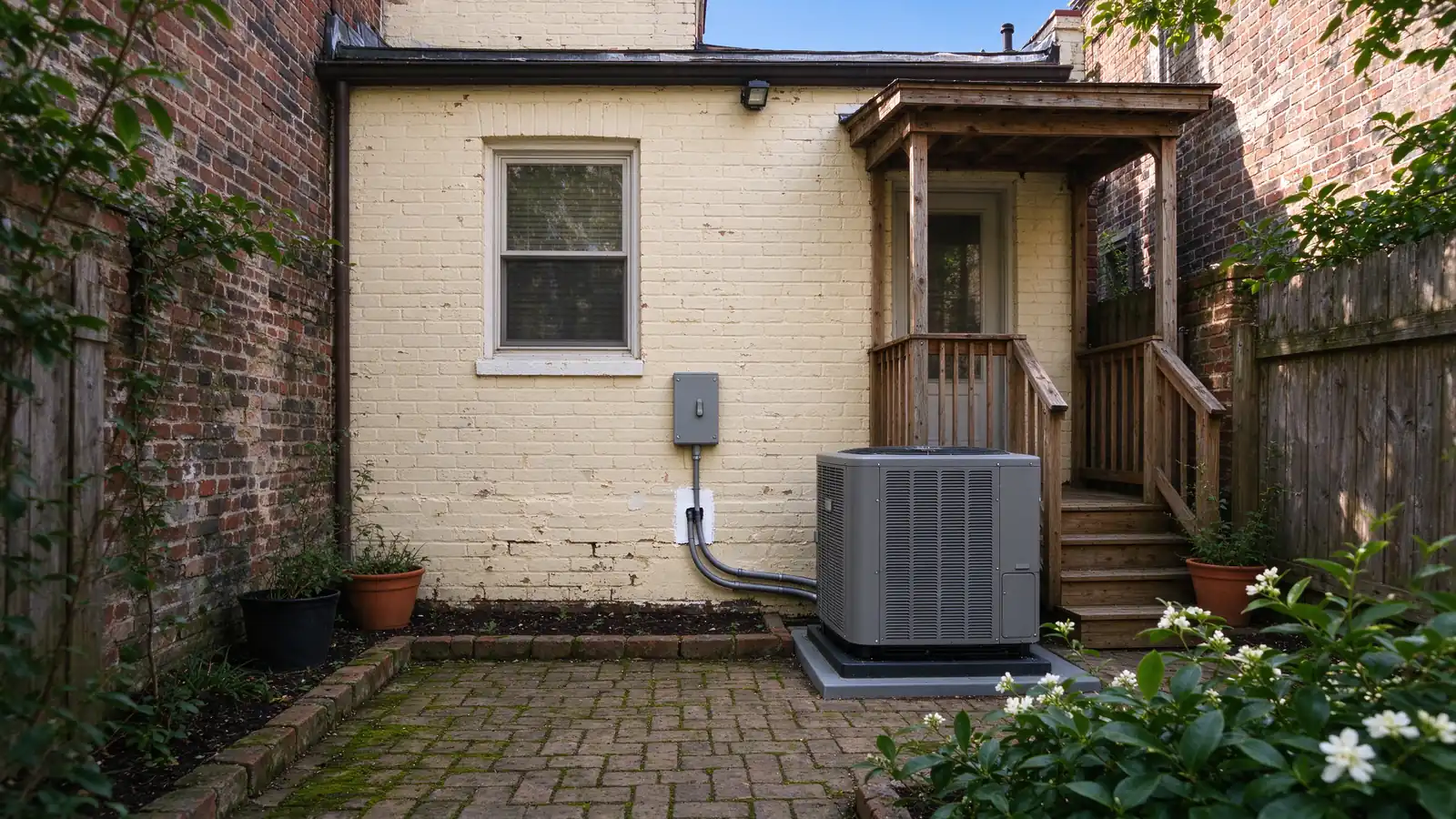
Most Capitol Hill owners call about the same two worries: a top floor that bakes every summer, and whether a new outdoor unit will tangle the house in historic review. At Perennial DC Heat Pumps we plan ducted air-source heat pump installation and heat pump replacement for rowhouses in Capitol Hill, Lincoln Park, Stanton Park and Kingman Park.
On the first visit we settle where the outdoor unit will live, because that spot fixes the line length, the review path and the pace of the whole job. The brand comes after.
Where should the outdoor unit go behind your Hill rowhouse?
Most of the time we put it on the ground behind the house. A rear-yard condenser stays off the historic roofline, keeps the copper run to a basement air handler short, and is usually invisible from any street, which is what keeps review simple.
The alley is not part of your yard, though. DDOT counts alleys as public right-of-way, so we keep the unit, its pad and any screen on your side of the rear property line. We also leave room so a car, a trash cart or a plowed snow pile cannot reach the coil; DC averages about 13.8 inches of snow a season, and alleys are where it gets pushed.
We only look at the roof when the rear yard is a patio built to the lot line, a parking pad or shared space nobody can give up. A roof position adds rigging, a stand the roof has to carry and a long vertical line run, and we still have to keep the unit out of sight from the street.
Will historic review hold up your Capitol Hill job?
Usually not, if the street cannot see the equipment. Inside the Capitol Hill or Kingman Park historic districts, the DC Department of Buildings sends the permit to the Historic Preservation Office before it issues. HPO’s published review tiers treat HVAC equipment clearly not visible from a street as minor, routine work, typically answered within 1 to 3 days.
Roof work moves slower. When HPO needs a site visit or mock-up and then finds the unit not visible from street views, staff review takes about 5 days. Equipment the street can see can go to the Historic Preservation Review Board, which meets on its own calendar.
HPO’s roof guidelines explain the thinking: keep HVAC equipment out of view from a public street, and where you cannot, screen it to match the building. Corner houses need extra care, since the side street can look straight into the backyard. Our historic homes guide walks through the full review path.
Top floor too hot, basement too cold?
That complaint comes with the house. Capitol Hill’s district documentation describes mostly narrow two- or three-bay rowhouses several stories tall, and every floor carries a different load. The top floor sits under a roof that cooks in July, when the normal daily high at Reagan National is 89.6°F, while the basement stays cool. One basement air handler has to push air up two or three floors through whatever chase the house allows.
Where there is no clean vertical chase, we usually plan a second air handler in the attic or a top-floor closet for the bedrooms and let the basement unit handle the parlor and kitchen floors. That can mean two outdoor units, or one larger unit feeding two indoor sections where the manufacturer offers that pairing. Our rowhouse guide compares the layouts, and the ductwork service page explains when your existing ducts can stay.
We size each section to a room-by-room load at 14°F, the ENERGY STAR heating design temperature for Washington, never to the tonnage on the old nameplate. The sizing guide shows how we do it, and the air-handler page covers the overflow protection we fit when a cabinet sits above finished plaster.
Put these questions into a project brief
Describe what you know about the property. Technical unknowns can stay unknown.
Lincoln Park, Stanton Park, Kingman Park and the Hill itself
HPO lists 70 historic districts across the city, and their lines ignore neighborhood names. We check your exact address before we assume either review path.
Capitol Hill
The DC Office of Planning describes Capitol Hill as older rowhouses, alleys and public spaces. If your house has a deep front garden, remember that DDOT often treats the strip between sidewalk and building as public space, so we answer that question before we ever draw a front-yard condenser.
Lincoln Park
Lincoln Park grew up around its square with housing much like the rest of the Hill. If your house faces the park, the front elevation is about as public as a facade gets, so we keep all equipment at the back.
Stanton Park
Stanton Park also grew around its own square, with Hill-style rowhouses. If your lot backs onto a narrow alley, the line set and the condenser end up competing for the same few feet, and we lay both out together.
Kingman Park
Kingman Park became a historic district in 2018. If your address falls inside it, exterior equipment takes the same DOB-to-HPO route as the rest of the Hill, and when we move a replacement unit to a new spot, the permit drawings show it as a new exterior change.
From first visit to startup on the Hill
We start with a load calculation and a site visit, photographing your rear elevation and roof from the street. Placement drawings come next, then we line up the DOB filing: the Class E refrigeration permit for equipment up to 120,000 BTU/h is $50.60, a general electrical instant permit is $22 and a heavy-up instant permit is $64.90.
Inside a district, DOB routes the filing to HPO before it issues. Installation, inspection and startup follow, and if you are claiming a DCSEU rebate, we assemble the paperwork so it goes in within 30 days of installation. Our quote checklist lists what every estimate should name.
What will a Capitol Hill heat pump cost you?
Our typical range for a whole-home ducted installation or like-for-like replacement is $8,000 to $18,000 before rebates. The written estimate after the site visit sets your price. On the Hill, the things that push a job above that range are a roof position with rigging, a second air handler for the top floor, new duct chases opened through plaster, a service heavy-up, or a screen that review asks for.
If you are leaving gas heat behind, DCSEU’s current tiers reimburse $4,000 for an ENERGY STAR ducted heat pump that replaces gas heat and $5,000 for an ENERGY STAR Most Efficient model, paid after installation. Our conversion service page and the rebate guide explain the fuel-removal proof. The cost guide and estimator separate base scope from extras, and our contact page takes your project details.
Neighborhoods next door to the Hill
Dupont Circle, Logan Circle and Shaw share the historic-review question, with condo documents on top. Downtown, Navy Yard and Southwest covers condo units in taller buildings. Brookland and Northeast mixes detached houses with rowhouse blocks. Every neighborhood we cover is on the service areas page.
Questions for this area
Can a Capitol Hill condenser sit in the alley behind the house?
No. DDOT treats the alley as public right-of-way, so we set the outdoor unit, its pad and any screen on your side of the rear property line, with enough clearance that cars, trash carts and plowed snow cannot reach the coil.
How long does HPO take to clear a hidden rear-yard heat pump on Capitol Hill?
When no street can see the unit, HPO lists it as minor, routine work, typically answered within 1 to 3 days after DOB forwards the permit. A roof unit that needs a site visit takes about 5 days, and visible equipment can go to the Historic Preservation Review Board, so we plan for a hidden spot first.
Does a Lincoln Park or Stanton Park address automatically get historic review?
Not automatically. District lines do not follow neighborhood names, so we look up your exact address on HPO's district map. Inside the Capitol Hill district, DOB sends the permit to HPO; outside it, the DOB mechanical permit moves on its own.
What does a whole-house ducted heat pump cost on a Capitol Hill rowhouse?
Our typical range for a whole-home ducted installation or like-for-like replacement is $8,000 to $18,000 before rebates, and the written estimate after the site visit sets your price. On the Hill, a roof position, a second air handler for the top floor, new duct chases or a service heavy-up raise it.
Can one air handler serve all three floors of a Capitol Hill rowhouse?
Only if a vertical chase can carry supply and return air to every floor. Without one, we usually plan a second air handler in the attic or a top-floor closet for the bedrooms while the basement unit covers the lower floors, each sized to a room-by-room load at 14°F.