
Your condo’s heat pump is failing, and the first thing you want to know is whether you can simply swap it. In a Downtown, Navy Yard or Southwest building, we settle which parts of the system you may legally change before we talk about which unit to buy. At Perennial DC Heat Pumps we plan ducted air-source heat pump replacement for condo units that have their own equipment, and DC Code § 42-1902.24 leaves any exterior part of that answer to your condominium’s own documents.
That question dominates here because so many homes are stacked. The DC Office of Planning’s Central Washington element notes that downtown residences often share buildings with offices and shops, and its Lower Anacostia Waterfront element records newer high-rise housing across Capitol Riverfront.
Which parts of your unit’s system are yours to change?
Usually what sits inside your unit, and very little beyond it. Under DC Code § 42-1902.06, unless the instruments say otherwise, ducts, conduits and apparatus serving more than one unit are common elements, while apparatus outside your unit that serves only you, such as on a balcony or patio, is a limited common element.
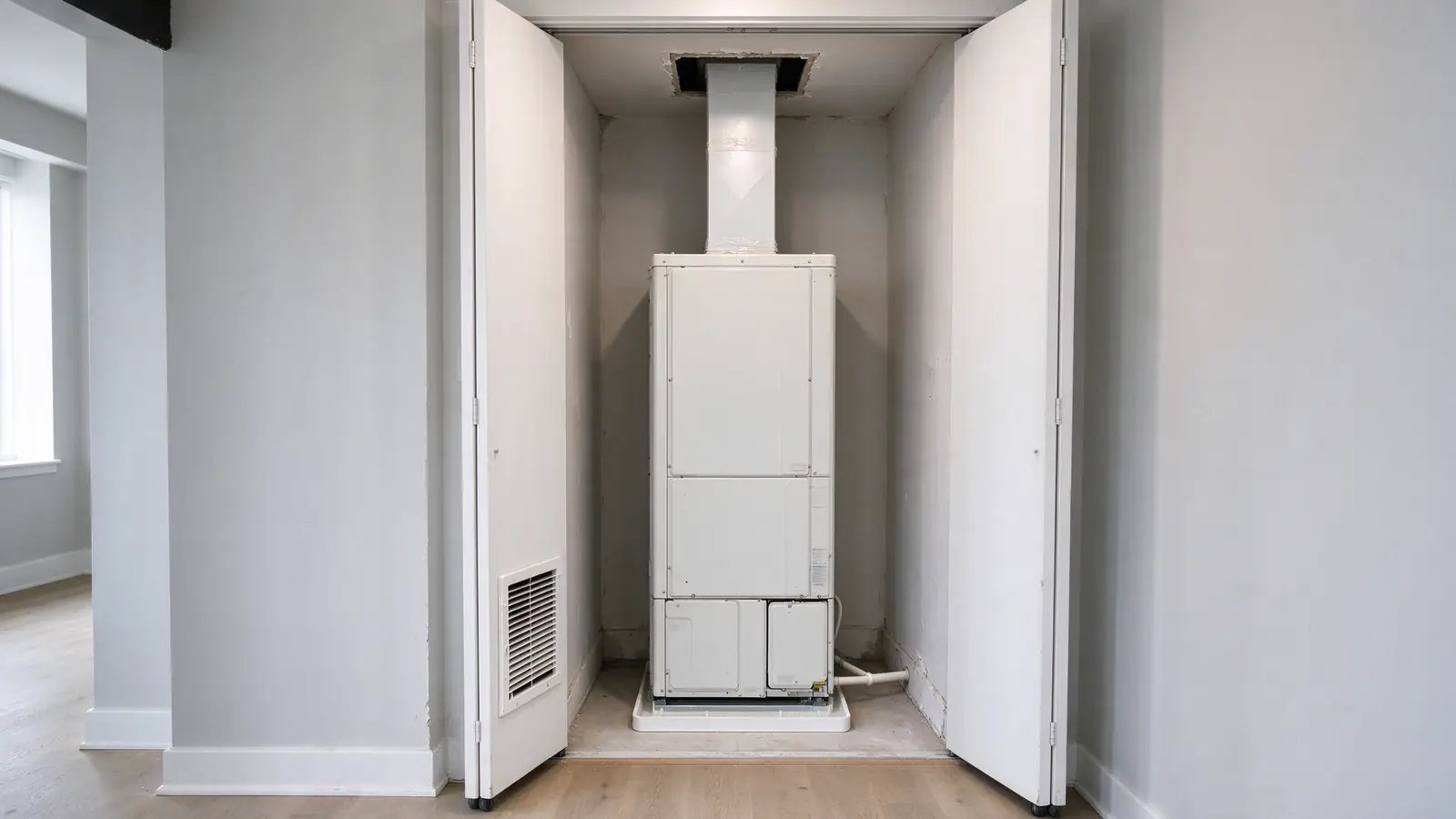
That split sets our scope. An air handler in your hall closet is normally yours to replace. A condensing unit on a shared roof deck sits on common property even when it serves only your apartment, so moving it, upsizing it or changing its pad becomes an exterior change governed by the declaration and bylaws. We read those with you first, then ask management for its alteration and contractor rules. Our condo heat pump guide lists the documents worth requesting.
Split system or water loop: what does your building have?
We plan split air-source systems: an outdoor unit with a fan, two copper refrigerant lines and an indoor coil with a blower. Some larger buildings instead give each apartment a water-source heat pump on a shared condenser-water loop, or serve every unit from a central plant. We do not take on those systems, and a residential replacement price does not apply to them.
You can usually tell in a few minutes. A water-source cabinet has water pipes and valves feeding it and no outdoor unit of its own, and its model plate usually says so. An air-source unit has refrigerant lines leaving the cabinet for a condenser somewhere outside. If your building, rather than one owner, wants to rework a central system, our commercial heat pump page explains why that is a different kind of project.
Will your new unit drip on the balcony below?
It can, unless we plan for it. A balcony condenser sheds defrost meltwater and summer condensate, and in a tower that water can land on a neighbor’s balcony. We settle the drain route before ordering equipment, along with the unit’s weight and how it anchors to the slab.
Sound travels between stacked homes too. DC limits air-conditioning and heat pump equipment to 60 dB(A) at the property line under 20 DCMR § 2801.2, as reprinted in the DOB noise handbook. We compare each candidate model’s rated sound level with its distance to the nearest bedroom window or terrace.
Sizing a mid-floor unit is different from sizing a rowhouse. Floors and ceilings shared with heated neighbors lose little heat, while a glass corner unit can lose a great deal. We run a room-by-room load checked against ENERGY STAR’s 14°F heating design for Washington, explained in the sizing guide, so your replacement does not just copy an oversized original.
Your circuits come from your unit’s own panel, but the feeder to that panel belongs to the building. When a larger heat pump or added backup heat needs more capacity, the electrical requirements guide explains why that work can need building approval as well as a DOB electrical permit.
Put these questions into a project brief
Describe what you know about the property. Technical unknowns can stay unknown.
Towers, townhouses and lofts from Penn Quarter to the West End
Downtown and Penn Quarter
Penn Quarter has a cluster of homes around 7th and D Streets NW, often above shops or offices. If your residential floors share a roof or mechanical deck with a commercial owner, the approval path can run through more than one party.
Navy Yard and Capitol Riverfront
Newer high-rises dominate Capitol Riverfront, yet older rowhouse blocks remain near Capitol Hill. If you own one of those rowhouses, it is an ordinary house job with its own yard or roof, covered by our rowhouse guide, not a condo replacement.
Southwest Waterfront
Southwest mixes modernist lower-density housing with taller towers, and the Wharf added apartments. A townhouse on its own lot may control its condenser outright, while a waterfront tower unit usually shares roof and riser decisions with the association.
Foggy Bottom and West End
Foggy Bottom combines older townhouses with mid-rise buildings, and the West End holds modern high-density development. Foggy Bottom is one of the historic districts listed by the Historic Preservation Office, so a townhouse inside its boundary sends exterior equipment through HPO. Equipment the street clearly cannot see falls in HPO’s minor-work tier, typically 1 to 3 days. We check your address against the district map, since a neighborhood name does not settle the boundary.
Our steps for a condo unit replacement
- We pull the declaration, bylaws and any alteration policy with you and note which parts they assign to your unit.
- We photograph the indoor and outdoor model plates so we know the system type and refrigerant.
- We run a load calculation for your unit itself.
- We send the exterior or roof part of the plan to the association, with equipment data and access needs such as an elevator reservation.
- We line up the DOB mechanical permit before work starts; the published fee for the refrigeration or instant mechanical permit is $50.60.
- After installation and commissioning, we keep the AHRI certificate, invoice and permit together for your rebate file.
Individual condo and co-op units in larger buildings can qualify for current DCSEU rebates. If your unit is already heated by electricity, it falls in the electric-replacement tiers, $1,000 for ENERGY STAR or $1,500 for Most Efficient, and DCSEU wants the claim within 30 days of installation. The DC rebate guide covers the paperwork.
What a condo heat pump replacement costs here
Our typical range for a whole-home ducted installation or like-for-like replacement is $8,000 to $18,000 before rebates. The written estimate after the site visit sets your price. Condo jobs drift above it for building reasons: hoisting equipment to a roof, a refrigerant line rerouted through a shared chase, work windows the building sets, a feeder upgrade the association controls, or an air handler that will not fit the existing closet. A small one-bedroom still starts from the same range; we price it from the site visit.
The cost guide explains what our range includes, and the cost estimator separates the base from those extras. Hold any estimate up to our quote checklist, then request an estimate with your building’s rules attached.
Next to Downtown and the waterfront
Rowhouse projects east of the Capitol are on the Capitol Hill page. Townhouse conversions north of downtown are on the Dupont Circle, Logan Circle and Shaw page, and Old Georgetown Board review is on the Georgetown page. The full list is on service areas.
Questions for this area
Can a Navy Yard or Southwest condo owner swap a balcony heat pump without association sign-off?
Not if the swap changes how the building looks. DC Code § 42-1902.24 bars a unit owner from changing the exterior appearance of the unit or any other part of the condominium except as the condominium instruments allow. A balcony is normally a limited common element, so we read the declaration and bylaws with you before anyone orders a different-size condenser.
How can I tell whether my downtown apartment runs on a water loop instead of an air-source split?
Look for an outdoor unit. An air-source split sends two copper refrigerant lines from the indoor cabinet to a condenser on a balcony, roof or deck. A water-source unit has water pipes and valves at the cabinet, no outdoor unit of its own, and a model plate naming it. We plan air-source splits only, so a water-loop system is not a job we take on.
Do individual condo units in large Downtown towers qualify for DCSEU heat pump rebates?
They can. DCSEU's current rules allow individual condo and co-op units in larger buildings, with a DOB mechanical permit, an AHRI certificate for the matched system and a paid itemized invoice, submitted within 30 days of installation. A unit already heated electrically falls in the $1,000 or $1,500 electric-replacement tiers. Amounts change between program years, so we check dcseu.com when we write your estimate.
What does a like-for-like condo heat pump replacement cost in Downtown, Navy Yard or Southwest?
Our typical range for a whole-home ducted installation or like-for-like replacement is $8,000 to $18,000 before rebates, and the written estimate after the site visit sets your price. Condo jobs climb above it through roof hoisting, rerouted refrigerant lines in shared chases, building work-hour rules, a feeder upgrade the association controls or an air handler that will not fit the old closet.
Is a Foggy Bottom townhouse reviewed differently from a West End condo tower?
Usually, yes. Foggy Bottom is a listed historic district, so a townhouse inside its boundary sends exterior equipment to HPO, where units clearly not visible from a street are minor work, typically 1 to 3 days. A West End tower unit mostly answers to its condominium instruments. We check the address against HPO's district map first.